
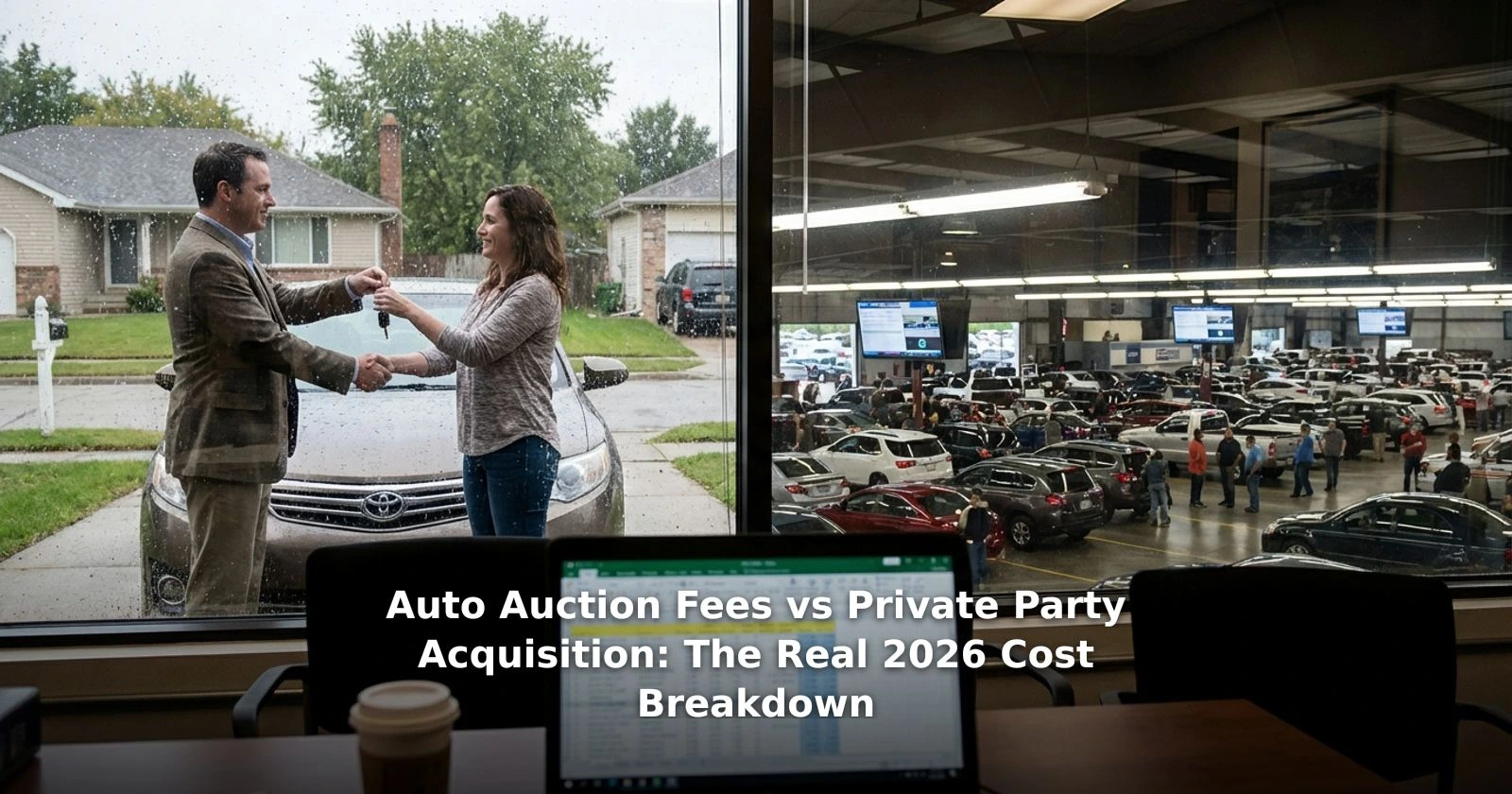
Most dealers assume the auction is the path of least resistance for inventory acquisition. 2 million units, the auto auction fees vs private party acquisition math stops favoring the lane.
Auction sourcing has quietly become one of the most expensive ways to stock a lot, and the dealers still treating it as a default channel are leaving significant margin on the table.
Key Takeaways
- Auto auction buyer fees now average $1,000–$1,500 per unit before transport or reconditioning
- Off-lease supply contraction is pushing hammer prices 8–12% higher year-over-year, eliminating the “buy cheap” assumption
- Private-party acquisition through first-party funnels reduces total per-unit cost to approximately $1,200 vs. $2,500+ at auction
- Scaling to 100–400 units/month requires compliance infrastructure, AI intake, and instant valuation technology
- The Vehicquire Auction Calculator lets dealers model their exact cost difference before committing to a channel
Table of Contents
- The True Per-Unit Cost of Buying at Auction in 2026
- Auto Auction Fees vs Private Party Acquisition at a Glance
- ROI Reality Check: First-Party Funnels vs Auction Bidding for Dealer Groups
- Scaling Private-Party Acquisition to 100–400 Units/Month: Compliance and Workflow Requirements
- Key Takeaways
- Frequently Asked Questions
- What are the average auto auction buyer fees in 2026?
- Is private-party vehicle acquisition legal for dealers at high volume?
- How does AccuTrade API technology improve private-party acquisition?
- Can wholesalers benefit from private-party acquisition, or is it only for retail dealers?
- What is the minimum volume where private-party funnels make financial sense?
The True Per-Unit Cost of Buying at Auction in 2026
The sticker price at auction is the hammer price. Everything else is the real cost. At Manheim and ADESA, buyer fee tiers in 2026 typically start at $300–$700 on lower-priced units and scale to $1,500 or more on vehicles over $20,000.
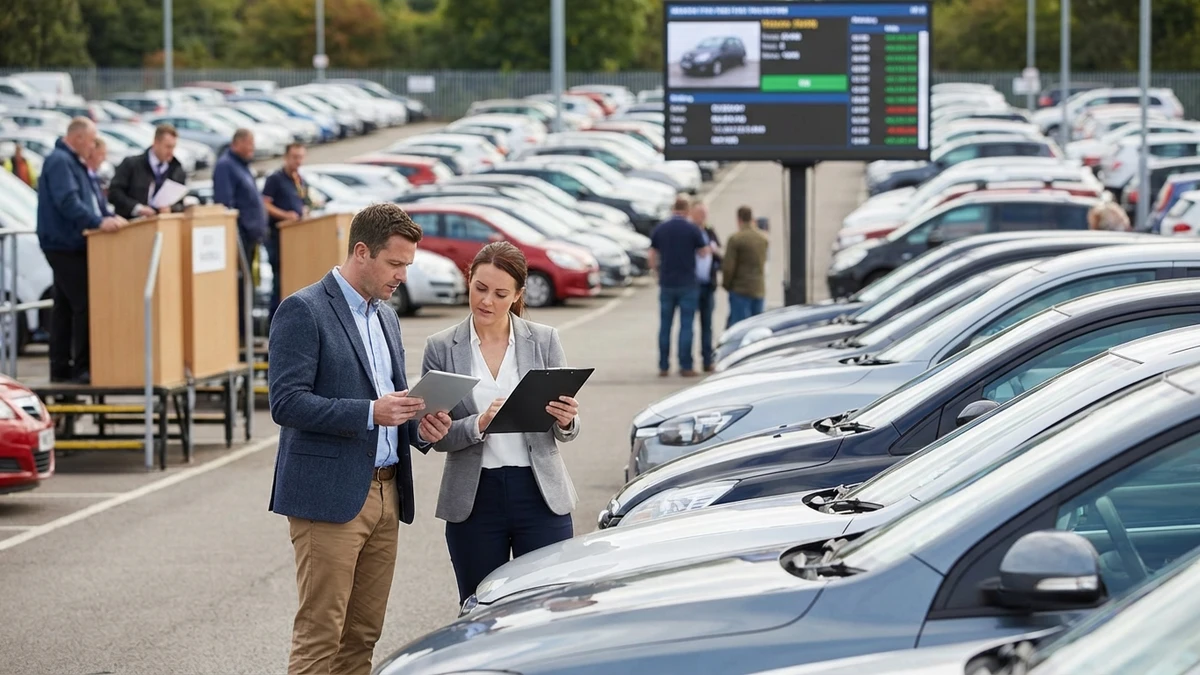
OVE (Online Vehicle Exchange) and similar digital lane platforms add access fees on top of that. Arbitration risk reserves, condition report fees, and title handling charges stack further, often adding $150–$300 per unit before the vehicle moves an inch.
Transport and logistics are where the math gets uncomfortable. With logistics premiums running 15–25% of hammer price in 2026, a unit that hammers at $20,000 can carry $3,000–$5,000 in transport costs alone.
Add the industry-average reconditioning spend of $800–$1,200 per unit, plus floor plan carrying costs for vehicles sitting 7–14 days post-auction before reaching retail-ready status, and the true landed cost on that same $20,000 unit reaches $25,000–$28,000 before a single dollar of profit is possible.
The off-lease supply contraction has made this worse. Pre-2026, the off-lease pool ran above 5 million units annually. 2 million, the direct result of the 2022–2023 new vehicle shortage reducing lease originations.
Fewer desirable units in the lanes means more dealers bidding on the same cars, and hammer prices are reflecting that with 8–12% year-over-year increases. The assumption that auction sourcing delivers below-market inventory is no longer valid for most segments.
EV and PHEV inventory adds another layer of cost. Battery condition reports, EV-specific arbitration windows, and competitive bidding on desirable electric inventory add $200–$500 per unit in fees that don’t apply to ICE vehicles.
For dealers building out EV inventory through auction lanes, that premium is a permanent line item, not an anomaly. are increasingly treating auction as a last resort rather than a first call.
Auto Auction Fees vs Private Party Acquisition at a Glance
| Cost Factor | Auto Auction | Private Party |
|---|---|---|
| Buyer Fee | $1,000–$1,500 | $0 |
| Transport / Logistics | 15–25% of hammer price | Minimal or zero (seller delivers) |
| Reconditioning Estimate | $800–$1,200 | $600–$900 (pre-screened via AI intake) |
| Valuation Speed | 24–72 hrs post-lane | Instant via AccuTrade API |
| Exclusivity | None (same inventory available to all buyers) | Exclusive (one buyer, one seller) |
| Scalability | Limited by lane access and floor plan capital | 400+ units/month with funnel infrastructure |
| EV / PHEV Handling | $200–$500 in additional fees | Street-sourced with condition disclosure upfront |
| Estimated Total Per-Unit Cost | $2,500–$4,200+ | ~$1,000–$1,400 |
Note: These figures represent blended averages for franchise dealers and multi-rooftop groups operating in mid-to-large U.S. markets. Actual costs vary by region, vehicle segment, and acquisition volume. When the auto auction fees vs private party acquisition comparison is laid out side by side, the per-unit cost gap is difficult to rationalize. The table above reflects real cost structures, not best-case scenarios. Use the [vehicle auction calculator](https://vehicquire.com/auction-calculator/) to run your own numbers against your actual hammer prices, transport lanes, and recon spend.
ROI Reality Check: First-Party Funnels vs Auction Bidding for Dealer Groups
The numbers here are hard to argue with. A franchise dealer group acquiring 200 units per month at an average total auction cost of $2,500 per unit is spending $500,000 monthly on acquisition overhead.

Shift that same volume to private-party sourcing at $1,200 per unit and the monthly spend drops to $240,000. 12 million annually, before accounting for the higher retail gross that comes with exclusive private-party units that haven’t passed through competing hands.
What rarely gets mentioned in the general “go private-party” conversation is that auction bidding is operationally expensive beyond the fees. It requires dedicated buyer staff, active lane access accounts, floor plan capital tied up for 7–14 days, and transport coordination across multiple locations.
A properly structured first-party funnel with AI Intake Systems automates lead qualification, condition disclosure, and offer generation, reducing labor overhead per unit significantly compared to staffing a physical auction presence.
using custom AccuTrade API technology and first-party funnels, deliver instant, data-backed valuations directly to private sellers at the top of the funnel. That eliminates the negotiation back-and-forth that slows private-party deals and makes dealers look less credible than a consumer who just checked KBB or CarGurus.
When a seller receives an instant, branded offer tied to real market data, conversion rates climb and cost-per-acquisition drops.
For multi-rooftop dealer groups, the centralized funnel model is particularly compelling. A single private-party acquisition funnel can feed inventory to multiple rooftop locations simultaneously, something auction sourcing cannot replicate without duplicating buyer fees, transport costs, and floor plan exposure across each location.
Dealers who have shifted 60% or more of acquisition volume to private-party channels report 25–40% margin improvement on those units, a benchmark that holds across multiple franchise groups. accelerates inbound seller volume without increasing per-unit overhead.
Pro Tip: Before committing to any channel mix, run your actual numbers through the vehicle auction calculator. Most dealer P&L models underestimate transport and floor plan carrying costs by 20–30%, which means the ROI gap between auction and private-party is often larger than dealers expect.
Scaling Private-Party Acquisition to 100–400 Units/Month: Compliance and Workflow Requirements
Scaling private-party acquisition is not just a marketing problem. It is a compliance and operations problem first. C. § 32705), and state-specific dealer licensing requirements for high-volume private purchases.
In states like California, Texas, and Florida, high-volume private acquisition triggers additional dealer disclosure obligations that vary by transaction type and volume threshold.
AI Intake Systems handle the top-of-funnel screening that makes compliance scalable. Automated condition questionnaires, VIN decoding, lien check triggers, and seller identity verification run before a human ever touches the deal.
That screening layer reduces the risk of acquiring salvage-titled, flood-damaged, or liened vehicles at volume, which is exactly the category of risk that grows exponentially when volume scales from 30 units per month to 300.
Wholesalers face a specific version of this problem that the broader dealer-to-consumer sourcing debate rarely addresses directly. Auction-sourced inventory has already passed through one or more dealer hands, meaning the margin between street value and wholesale value has already been captured by whoever sold it into the lane.
Private-party sourcing puts the wholesaler first in line, capturing the full spread between what a private seller accepts and what the vehicle is worth at wholesale. That margin compression from regurgitated auction inventory is a structural disadvantage, not a temporary market condition.
The operational workflow for a 200-unit/month private-party program runs like this:
- Inbound funnel traffic drives private sellers to a branded landing page
- AI intake screening captures vehicle details, condition, VIN, and seller information automatically
- AccuTrade API instant offer delivers a data-backed valuation in real time
- Appointment scheduling confirms the seller for an in-store visit
- In-store condition verification validates the AI intake data against the physical vehicle
- Title and compliance check confirms clean title, odometer disclosure, and lien status
- Acquisition close completes the purchase with proper documentation
Each step in that workflow is systematized, not manual. Dealers who attempt to scale private-party acquisition without this infrastructure typically stall at 20–40 units/month. The bottleneck is almost always at intake screening or valuation delivery, where manual processes create delays that cause sellers to accept offers elsewhere.
If your current private-party volume has plateaued below 50 units/month, the issue is almost certainly process, not market demand.. When the auto auction fees vs private party acquisition question is framed correctly, it’s not really a sourcing debate. It’s a margin and scalability decision.
Dealers who build the infrastructure to acquire directly from private sellers at volume consistently outperform those who remain dependent on the lane, and the cost data in 2026 makes that case more clearly than ever. com).
Key Takeaways
- Auto auction buyer fees in 2026 average $1,000–$1,500 per unit in buyer premiums alone, before transport, reconditioning, or floor plan costs
- Off-lease supply has contracted from 5M+ units annually to approximately 3.2M units, intensifying auction competition and compressing per-unit margins
- Private-party acquisition through first-party funnels and AI intake systems reduces total per-unit cost to roughly $1,200 vs. $2,500+ at auction
- Dealers scaling to 100–400 units per month need compliance workflows and instant valuation technology, not just a different sourcing channel
- Use the vehicle auction calculator to model your exact per-unit cost difference before committing to an acquisition strategy
Frequently Asked Questions
What are the average auto auction buyer fees in 2026?
Buyer fees at major platforms like Manheim and ADESA typically range from $300–$1,500 per unit depending on vehicle sale price, with additional fees for condition reports, arbitration, and digital lane access. Total landed cost including transport and reconditioning commonly exceeds $2,500 per unit in 2026.
Is private-party vehicle acquisition legal for dealers at high volume?
Yes, but it requires proper dealer licensing, title handling procedures, and compliance with federal and state disclosure laws including the Truth in Mileage Act. Scaling above 50 units/month typically requires systematized intake and compliance workflows to avoid legal exposure.
How does AccuTrade API technology improve private-party acquisition?
AccuTrade API integration allows dealers to deliver instant, data-backed vehicle valuations to private sellers through their own branded funnels. This eliminates the negotiation friction that slows private-party deals and gives dealers a competitive edge over consumers using generic valuation tools like KBB or CarGurus.
Can wholesalers benefit from private-party acquisition, or is it only for retail dealers?
Wholesalers benefit significantly from private-party sourcing. Private-party vehicles have not been through auction lanes, meaning the wholesaler captures the full margin between street price and wholesale value, a margin that is already compressed when buying auction-sourced inventory that has passed through prior dealer hands.
What is the minimum volume where private-party funnels make financial sense?
Most dealers see positive ROI on private-party funnel infrastructure at 30 or more units per month. At 100+ units/month, the per-unit cost savings and margin improvement typically generate 10–20x return on the cost of the acquisition program.