Most dealerships run Google Ads with a strict retail mindset. They chase car buyers, showroom traffic, inventory clicks, and broad dealership leads. When applied to vehicle acquisition, that approach completely wastes your advertising budget.
You are trying to reach vehicle owners who want to sell, not shoppers who want to buy. Because of this massive difference in user intent, performance max vehicle acquisition campaigns need a completely different strategy from standard retail dealership campaigns.
Vehicquire operates far outside the boundaries of ordinary automotive marketing. We help franchise dealers, wholesalers, and buying centers scale private-party vehicle acquisition. Our team builds systems using first-party funnels, AI intake, paid traffic, and acquisition-specific tracking.
We are the only agency built 100% for private-party vehicle acquisition using custom AccuTrade API technology and first-party funnels. We partner with dealers who want to turn ad spend into purchased units, not just clicks or form fills.
- Performance Max requires clean conversion data and strong seller-focused creative to acquire vehicles effectively.
- Dealerships must separate buyer keywords from seller keywords to avoid wasting budget on retail search traffic.
- Successful acquisition campaigns rely on strict local radius targeting and clear buy box parameters.
- First-party lead funnels must replace standard dealership inventory pages to capture high-intent private sellers.
- Cost per acquired car and purchased units matter far more than basic cost per lead metrics.
Retail Mindset Wastes Acquisition Budget
In 2026, most dealerships run Google Ads with a retail mindset that wastes their acquisition budget. They chase car buyers, showroom traffic, and inventory clicks. This approach fails when the goal is to reach vehicle owners who want to sell their cars. To fix this, performance max vehicle acquisition campaigns need a completely different strategy from standard retail dealership campaigns.
General dealership advertising targets shoppers who want to buy a vehicle. Dealership acquisition marketing must target private-party sellers who want to cash out or trade in. When you mix these two goals in a single campaign, the search algorithm gets confused. It optimizes for the easier conversion, which is usually a casual shopper filling out a basic lead form. You end up spending your budget on the wrong audience.
Stop Bidding on Buyer Keywords
Seller-intent targeting matters because intent determines your return on ad spend. You must aggressively filter out parts, repair, service, and casual research traffic that will not produce acquired vehicles. A clean Google Ads account separates these intents completely.
- Buyer keywords include terms like “used trucks for sale”, “SUVs near me”, or “best dealership deals”.
- Seller keywords include terms like “sell my car”, “cash offer for my car”, and “trade in value”.
- A seller who types “what is my car worth” wants a fast appraisal, not an inventory page. If you send a private-party seller to a standard dealership website, they will leave. They want a simple process, payoff help, and local buyer trust. They do not want to see your retail inventory graphics or generic “shop now” buttons.
Dealership owners and used car managers need a system designed specifically to buy cars from private sellers. Vehicquire is the only agency built 100% for private-party vehicle acquisition using custom AccuTrade API technology and first-party funnels. We help franchise dealers, independent buying centers, multi-rooftop groups, and wholesalers turn paid traffic into purchased units. Our custom first-party lead funnels and AI intake systems ensure your budget goes toward actual acquisition opportunities.
A successful vehicle acquisition strategy connects paid traffic directly to your buy desk and appraisal workflow. Google Ads only generates real ROI when it fuels a dedicated private-party acquisition machine.
Build Performance Max Vehicle Acquisition Campaigns Around Seller Intent
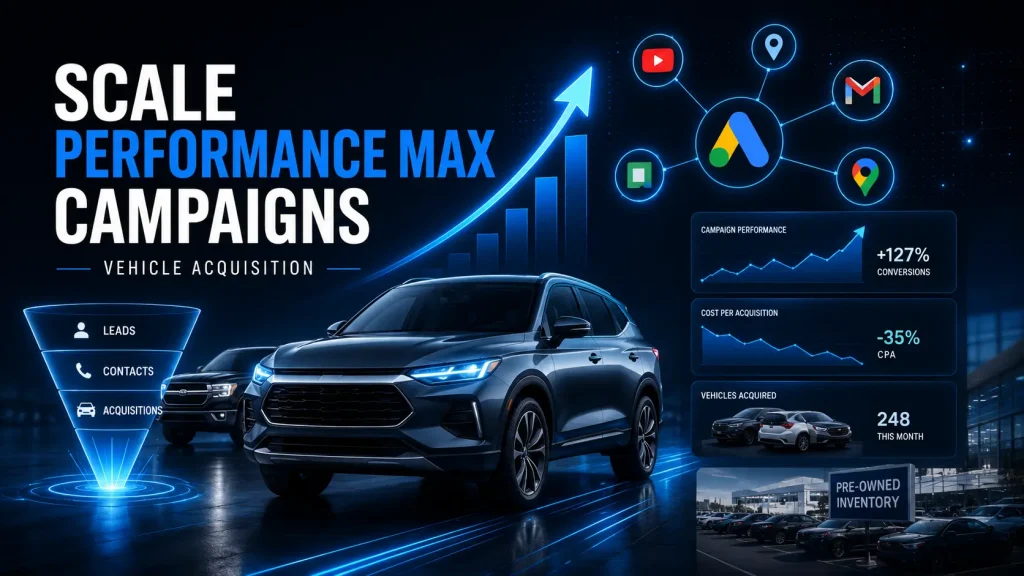
Google Ads offers massive reach for dealerships wanting to buy cars from private sellers. Well-built performance max vehicle acquisition campaigns can support your buy desk across Google’s entire network. This includes Search-adjacent placements, YouTube, Display, Discover, Gmail, and Maps.
You can feed the system first-party data from past sellers to guide the algorithm. However, PMax is never a magic campaign type that works on autopilot. It requires focused audience signals, clear search themes, and accurate offline conversion feedback to succeed in 2026.
Structure Campaigns for Your Specific Buy Box
Dealership acquisition marketing requires strict boundaries. You must build campaigns around your dealership buy box, vehicle segments, budget, and purchased-unit goals. A campaign architecture designed for a multi-rooftop group will look different from one built for an independent buying center or wholesaler. Better structure helps ad spend create more acquisition opportunities instead of just more traffic. You must tell Google exactly what you want to buy.
Control Your Market with Strict Local Targeting
Local targeting dictates your acquisition success. Zip-code targeting and radius targeting keep your ads focused on realistic private sellers. Market density and commute patterns affect how far a private-party seller will drive for an appraisal. A lead from 100 miles away might look cheap in Google Ads.
It will likely never turn into a purchased unit. Dealership inventory acquisition relies on a realistic pickup or appraisal radius. Tie your local targeting directly back to your cost per acquired car reporting.
Filter traffic with Negative Keywords
Seller-intent targeting makes or breaks your budget. ” You must aggressively filter out buyer traffic. Parts, repair, service, and casual research clicks will not produce acquired vehicles. ” Your seller-intent Google Ads must block retail keywords entirely.
A strong sell my car Google Ads strategy relies heavily on negative keyword lists to protect your daily spend.
Compare Google Ads for Vehicle Acquisition
Performance Max works best as a scaling layer. It supports other campaigns across the Google network. Search Ads remain the highest-intent channel. Sellers actively type “sell my truck near me” when they need immediate solutions. Responsive Search Ads help you test offer-
led messaging. Dynamic Search Ads capture long-tail seller queries that exact match lists miss. Display retargeting and YouTube retargeting re-engage sellers who visited your acquisition funnel but did not submit their vehicle details. Performance Max fits into this mix as a scaling and multi-channel support layer. It is rarely the only campaign you need to run.
Your ads must target sellers, not car shoppers. Many dealerships waste budget because they bid on buyer keywords. Terms like “used trucks for sale” or “best dealership deals” attract people who want to spend money. You need people who want to get paid. Seller-intent Google Ads rely on specific phrases.
Focus on terms like “sell my car near me”, “instant cash offer”, and “what is my car worth”. You must aggressively filter out retail keywords using negative keywords. Block searches for parts, service, and casual research. These clicks will never produce an acquired vehicle.
How Different Google Ads Channels Compare for Buying Cars As of 2026
Google Search Ads capture the highest seller intent available. A private-party seller typing “sell my truck near me” wants an immediate offer. You can use Responsive Search Ads to test offer-led messaging against these high-intent searches. Meanwhile, Dynamic Search Ads help you capture long-tail seller queries that manual keyword lists miss.
A performance max vehicle acquisition campaign fits into this mix as a multi-channel support layer. It scales your reach across the Google network while working alongside your existing search and retargeting efforts.
| Campaign Type | Seller Intent | Targeting Control | Scalability | Creative Needs | Tracking Difficulty | Best Use Case | Main Risk |
|---|---|---|---|---|---|---|---|
| Performance Max | Mixed | Low | Very High | High | High | Broad network scaling | Spending on low-intent inventory |
| Search Ads | Very High | High | Medium | Low | Medium | Capturing active sellers | High cost per click |
| Responsive Search Ads | High | High | Medium | Medium | Medium | Testing offer messaging | Diluted ad copy |
| Dynamic Search Ads | Medium | Medium | High | Low | Medium | Long-tail query capture | Matching irrelevant searches |
| Display Retargeting | Medium | High | High | High | Low | Re-engaging lost visitors | Ad fatigue |
| YouTube Retargeting | Medium | High | High | Very High | Medium | Building trust through video | High production costs |
| Branded Acquisition | Very High | Very High | Low | Low | Low | Protecting local market share | Limited growth volume |
Aligning Campaign Types with Seller Behavior
Many sellers visit a buying center website to check trade-in value and then leave. They often compare prices with local dealers and national online platforms. Display and YouTube retargeting campaigns keep your cash offer visible while they weigh their options. These visual formats remind sellers of your fast appraisal process and easy payoff support.
Running multiple Google Ads for buying cars demands tight integration. Ad spend easily goes to waste without proper routing to your buy desk. The platform is the only agency built 100% for private-party vehicle acquisition using custom AccuTrade API technology and first-party funnels. We connect your paid traffic directly to AI Intake Systems. This unified approach turns fragmented clicks into actual purchased units for your dealership.
Stop Sending Private Sellers to Dealership Inventory Pages
Dealerships often make the mistake of routing acquisition traffic to standard retail pages. A private-party seller wants to sell their car, not browse your used truck inventory. If your ad or landing page talks mainly about dealership inventory, the seller will bounce. Your seller-offer ads must communicate clear offers and simple process language. They should highlight fast appraisal messaging, no-hassle selling, payoff help, and local buyer trust.
Performance Max asset groups require specific creative elements to attract these sellers. Replace generic dealership photos and “shop now” retail graphics with targeted assets designed to buy cars.
- Seller-focused headlines: Write copy about instant offers and easy drop-offs.
- Buying center value propositions: Explain why selling to your dealership is faster than a private sale.
- Targeted video assets: Show real people conducting appraisals at your buying center.
Build First-Party Acquisition Funnels
Your landing page must act as a dedicated first-party acquisition funnel designed for owners. In 2026, standard contact forms do not work for vehicle acquisition. You must collect specific details to qualify the lead properly and speed up the buy desk workflow.
Make sure you capture the VIN or license plate data, exact mileage, vehicle condition, title status, and seller timeline. Adding photo upload options can also help your used car manager evaluate the vehicle faster.
Sellers have anxiety about the transaction process. Your landing page must answer common seller questions directly to build trust before they visit the store. Explain exactly how you handle loan payoffs and lien releases. Detail your inspection processes clearly so they know what to expect upon arrival. You should also clarify whether the dealer buys damaged vehicles or high-mileage cars.
We see many dealers lose purchased units because their pages look like traditional retail sites. The platform is the only agency built 100% for private-party vehicle acquisition using custom AccuTrade API technology and first-party funnels. We connect paid traffic to AI Intake Systems that convert visitors into scheduled appraisal requests. Book a Discovery Call today to see how our custom funnels can increase your purchased units this month.
Frequently Asked Questions
Why shouldn’t I use my dealership’s retail Google Ads account for vehicle acquisition?
Retail campaigns are built to find car shoppers looking for inventory, which wastes your budget on buyer keywords rather than seller-intent queries. A dedicated acquisition strategy aggressively filters out parts, service, and buyer traffic to focus exclusively on owners typing phrases like “sell my car” or “instant cash offer.”
How does Performance Max find private-party sellers?
Performance Max uses Google AI and audience signals to place your buying center value proposition across Search, YouTube, Display, Discover, and Gmail. It requires clear search themes and strong offline conversion imports to ensure the algorithm optimizes for actual purchased units instead of low-quality form fills.
What conversion actions should I track in a PMax acquisition campaign?
You must move beyond basic clicks and optimize for high-intent actions like VIN intake, license plate lookup, appraisal requests, and trade-in completions. Integrating your CRM for offline conversion imports allows Google Ads to see which leads actually result in appointments, inspections, and acquired vehicles.
Can I control which geographic areas my acquisition campaigns target?
Yes, precise zip-code targeting and radius targeting are essential to ensure leads fall within a realistic pickup or appraisal distance. A lead from outside your buying radius might look good on a Google Ads report, but it rarely turns into a purchased unit for your dealership.
Why is my cost per lead low but my cost per acquired car high?
Cheap seller leads often come from users outside your market, people with unrealistic loan payoff expectations, or vehicles that do not fit your dealership buy box. To fix this, you must feed purchased-unit data back into Google Ads so Smart Bidding prioritizes the offer-to-close rate rather than just generating cheap traffic.