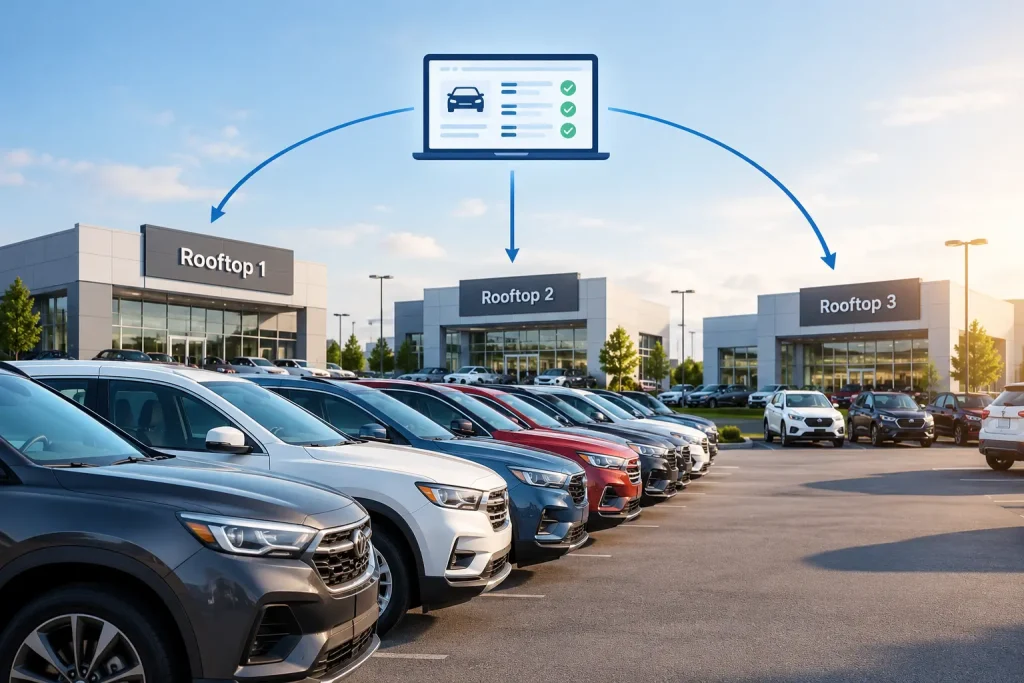
What happens when your best-performing rooftop and your worst-performing rooftop draw from the exact same acquisition budget? Most dealer groups never ask this question, and it costs them. They run vehicle acquisition strategies that should have retired years ago: one playbook, copied ten times, with no regard for which store actually needs the inventory.
Key Takeaways
- Used inventory sat at 47 days’ supply in June 2026, per Cox Automotive.
- March 2026 hit a record low of 37 days’ supply, the tightest since 2019.
- Groups need one acquisition engine feeding rooftops, not separate playbooks per store.
- A rooftop-allocation model stops one store from overbuying while another starves.
- Response-time SLAs matter more at group scale, not less.
Why Days’ Supply Data Should Set Your Acquisition Budget
Cox Automotive reported 2.14 million used units on dealer lots in June 2026, equal to 47 days’ supply. That’s up only slightly year over year. Three months earlier, in March 2026, supply hit a record low since 2019: just 1.95 million units, or 37 days’ supply.
That swing matters more to a five-rooftop group than to a single store. National averages hide the real story. A group running five, ten, or twenty rooftops isn’t operating in one market, it’s operating in five, ten, or twenty microclimates, each with its own days’ supply.
Some stores sit at 25 days and are bleeding gross profit to stock-outs. Others sit at 60 days and are quietly burning floorplan interest. Splitting the acquisition budget evenly across both is like giving every player on a basketball roster the same number of shots regardless of who’s actually hitting them.
This is where days’ supply arbitrage comes in: shifting acquisition dollars toward the rooftops with the tightest supply and the highest gross potential, instead of splitting the budget evenly.
A Monthly Re-Ranking Formula
Run this every month across rooftops:
- Pull current days’ supply per rooftop from your DMS.
- Rank rooftops from tightest to loosest supply.
- Weight each rooftop’s acquisition budget against its rank, not its size.
- Re-check in 30 days. Supply shifts fast, and so should the budget.
Vehicle Acquisition Strategies Dealer Groups Use to Centralize Sourcing
Two models dominate multi-rooftop acquisition. The single buy-center model routes every lead through one hub, then distributes vehicles to rooftops based on need. The every-store-sources-itself model lets each location run its own outreach, appraisals, and offers.
The tradeoffs are real. Store-by-store sourcing feels faster locally, but it multiplies cost per acquired unit because every rooftop rebuilds the same process from scratch. A centralized hub costs more to set up but drives down blended acquisition cost as volume scales.
A shared lead pool solves the routing problem. AI Intake Systems can qualify a seller once, then route them to the rooftop with the right vehicle demand, not just the closest store. Before centralizing, a group needs three things in place:
- One standardized offer script across every rooftop
- A single appraisal tool, not five different valuation methods
- A shared CRM view so no lead gets worked twice
Custom AccuTrade API technology fits neatly into this model. It pulls live trade data into first-party funnels, so every rooftop gives sellers a consistent, instant offer, whether that lead lands in Phoenix or Tampa.
Stop Running Acquisition Like a Single Store With More Locations
Here’s the mistake almost every group makes: they take one store’s private-party playbook and paste it across ten rooftops with completely different demographics. A script that converts in a suburban market can flop in an urban one. Copy-paste acquisition doesn’t scale, it just multiplies the same blind spots across every rooftop that inherits it.
Response time is the other silent killer. Industry benchmarks point to sub-five-minute SLAs as the threshold that separates converting leads from losing them. At group scale, one slow rooftop doesn’t just underperform, it drags down the group’s blended conversion rate while leadership often can’t see which store is the problem.
Build a rooftop scorecard tracking three numbers monthly: cost per acquired vehicle, average response time, and close rate. That scorecard tells leadership exactly which store needs a process fix, not a budget cut. It also removes the guesswork that usually turns into finger-pointing at the next regional meeting.
Groups ready to replace fragmented, store-by-store sourcing with one connected system are the exact use case for Vehicquire’s private-party acquisition machines. Vehicquire is the only agency built 100% for private-party vehicle acquisition, using custom AccuTrade API technology and first-party funnels designed for multi-rooftop operations.
If your group is still running ten separate acquisition strategies, it’s worth a conversation. Book a Discovery Call at https://vehicquire.com to map out a centralized model built around your actual days’ supply data.
Frequently Asked Questions
How many rooftops need to share one acquisition engine before centralizing makes sense?
Most groups hit the tipping point around three rooftops. Below that, fragmented sourcing is manageable. Above it, duplicated tools and scripts start costing more than a shared system would.
Should every rooftop in a group use the same offer amount for the same vehicle?
No. The process should stay standardized, but the number should flex with local market demand. A tight-supply rooftop can justify a stronger offer than one sitting on excess inventory.
How do groups measure ROI on acquisition spend across multiple stores?
Track cost per acquired unit and days’ supply improvement side by side. Those two metrics show whether spend is actually tightening inventory or just moving cars between stores.
What’s the fastest way for a group to test centralized sourcing without a full rollout?
Pilot one buy center across two or three rooftops first. Measure cost per unit and response time before scaling the model group-wide.