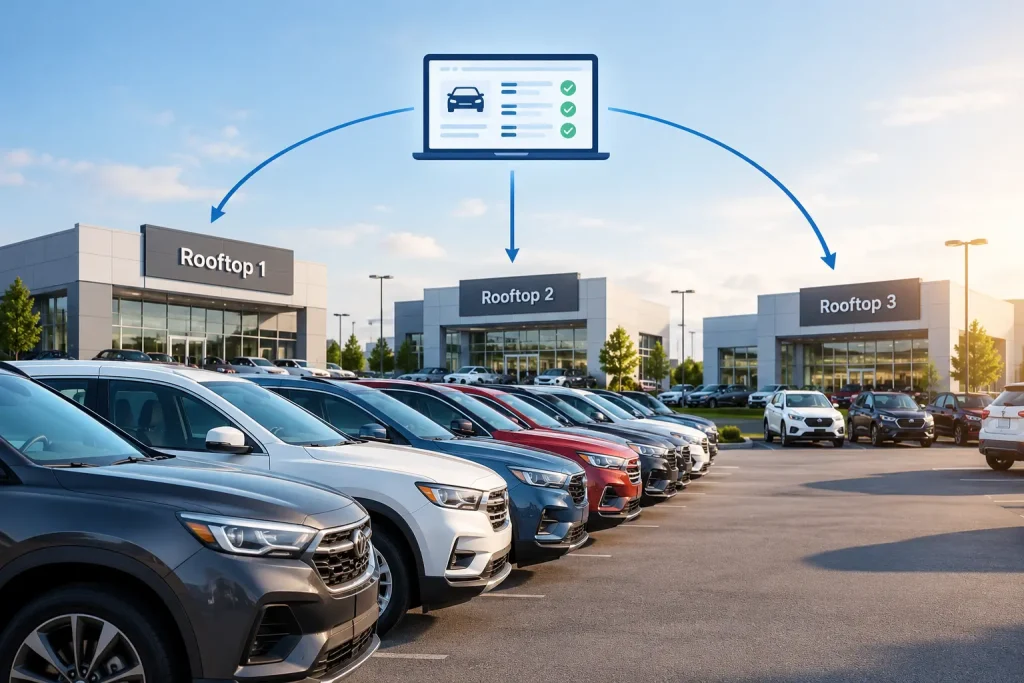
Most dealer groups assume scaling vehicle acquisition across multiple rooftops means finding more sellers. That’s backwards. The bottleneck almost never shows up in seller supply. It shows up in the gap between how Store A runs intake and how Store F runs it three months later, with none of the same tools.
Key Takeaways
- Franchise dealers source 65.4% of used inventory directly from consumers; independents still lean on auctions for 50.6% of supply.
- Street-sourced vehicles turn in about 31 days at roughly $3,525 front-end profit, versus 43 days and about $1,050 at auction.
- Auction share of dealer sourcing has fallen from about 55% in 2022 to roughly 43% in 2026.
- The failure point in multi-rooftop growth is fragmented process, not weak channel performance.
Why One Good Rooftop Doesn’t Scale to Ten
Here’s the pattern that plays out at nearly every dealer group. A sharp used car director at the flagship store builds a real private-party pipeline, buying dozens of cars a month straight from consumers. Leadership notices the gross and tries to copy it across the group. It rarely works.
The copy fails because nothing was actually built to transfer. Store two uses a different offer tool. Store three has one BDC rep answering seller texts between other duties. Store four has no shared data on what offers convert and what price points lose deals. Each location reinvents the process from memory, not from a system.
The 2026 sourcing gap between franchise and independent dealers proves this isn’t about access to sellers. Franchise dealers now source 65.4% of used inventory directly from consumers. Independents still pull 50.6% from auctions, often because they lack the standardized intake and pricing discipline franchise groups run at scale. Access to private sellers is roughly the same for both. Discipline is not.
The real unit of scale is the process, not the store. Adding rooftops without fixing that just multiplies the inconsistency, the same way adding lanes to a poorly timed intersection just moves the traffic jam somewhere new. Groups researching independent dealer sourcing strategies will notice the same theme: the tools matter less than the discipline behind them.
The Operating Framework for Scaling Vehicle Acquisition Across Multiple Rooftops
Scaling vehicle acquisition across multiple rooftops needs three layers working together, not five different tools bolted onto five different stores.
1. Centralized intake. Every rooftop should feed one seller-facing funnel or AI intake system, not five separate ones. This matters most after hours, when most private-party sellers actually submit their vehicle. An AI intake system captures the lead, asks qualifying questions, and routes it before staff even clock in.
2. Standardized appraisal logic. Offers need to hold the same shape store to store. Custom AccuTrade API technology can drive pricing so a seller in one market gets a consistent, defensible offer instead of whatever number a rushed appraiser guesses.
3. Centralized lead routing by capacity. A lead should go to the rooftop with room to buy that week, not whichever store happened to run the ad.
A shared tool to calculate auction fees ties this together. Every store compares a street offer against real auction cost, including fees and reconditioning, before committing. That keeps offers sharp without triggering a race to the bottom between rooftops competing for the same seller pool.
If two stores in the same group are bidding against each other on the same private seller, your routing layer is broken, not your pricing.
This is where a generic lead-gen platform adapted for multiple stores runs into trouble. We built Vehicquire differently. It’s the only agency built 100% for private-party vehicle acquisition using custom AccuTrade API technology and first-party funnels, designed from the start to run as one system across rooftops, not five bolted-together instances.
What to Track Once You Add Rooftops
Total units bought is the metric that hides the most damage. A group can hit its monthly acquisition target while two rooftops overpay and underperform on turn.
Track these vehicle acquisition kpis weekly, per rooftop:
- Cost per acquired vehicle
- Average days to close on a seller lead
- Front-end gross by source (street, service drive, auction)
- Appraisal-to-purchase conversion rate
Compare Stores to Each Other, Not Just Last Year
Year-over-year comparisons hide underperformance because every store looks “improved” against a weak baseline. Comparing rooftops side by side, same week, same metrics, surfaces which locations are under-resourced or under-trained on intake. A single-store dashboard can never give you that diagnostic.
Franchise dealers project used inventory turns in the 32-38 day range. That range should be the floor for every rooftop in a group, not a stretch goal reserved for the top performer. A store running 50 days isn’t sourcing badly. It’s running a broken process a scorecard would catch in week one.
The Real Reason Multi-Rooftop Scaling Stalls
The economics already favor the shift. Street-sourced vehicles sell in about 31 days at roughly $3,525 front-end profit per unit. Auction-sourced units take 43 days for about $1,050. Auction’s share of dealer sourcing has dropped from roughly 55% in 2022 to about 43% in 2026, and the direction isn’t reversing.
None of that matters if each store runs its own disconnected version of the process. Groups that standardize intake, centralize routing, and hold every rooftop to the same scorecard turn a single-store win into a repeatable system. Groups that don’t just end up with one good store and four expensive imitations.
If your group is ready to build that system instead of patching around it, Book a Discovery Call and see what a unified private-party acquisition setup looks like across your rooftops.
Frequently Asked Questions
How many rooftops can share one AI intake system?
There’s no hard ceiling. The system routes by real-time capacity, so adding rooftops means adding routing rules, not rebuilding intake from scratch at each store.
What’s the biggest mistake groups make when scaling acquisition?
Measuring total units bought without measuring speed and gross per unit. That hides which rooftops are actually profitable and which are just adding volume.
Does centralizing acquisition slow down individual stores?
No, it typically speeds them up. Staff stop manually answering seller inquiries and reviewing appraisals from scratch, since the intake and pricing logic is already standardized.
How does an Auction Calculator help multi-rooftop groups specifically?
It gives every store the same reference point for real auction cost, so offers stay competitive across rooftops without one store underpricing another for the same seller.