Florida buying centers that still treat a title transfer as a signature-and-drive-off event will spend the next few years explaining stuck inventory to their controllers. As private-party volume grows, the gap between groups that gate every VIN before funding and groups that fix titles after the car arrives will show up directly in days-to-front-line. The winning move is to run title readiness as an operating system, not a back-office chore.
Table of Contents
- Florida Title Transfer Rules Buying Centers Must Gate Before Funding
- What Happens When the Title Isn’t Clean?
- Build a VIN-Level Title-Readiness Scorecard
- Stop Treating Resale Titling as an Afterthought
- Frequently Asked Questions
The consumer sequence is the legal floor: the seller assigns the title, the buyer files HSMV 82040, the seller files HSMV 82050, and the application is due within 30 days. A buying center needs more evidence than that before money moves, and it needs it before the appraisal appointment, not after the unit arrives.
Florida Title Transfer Rules Buying Centers Must Gate Before Funding
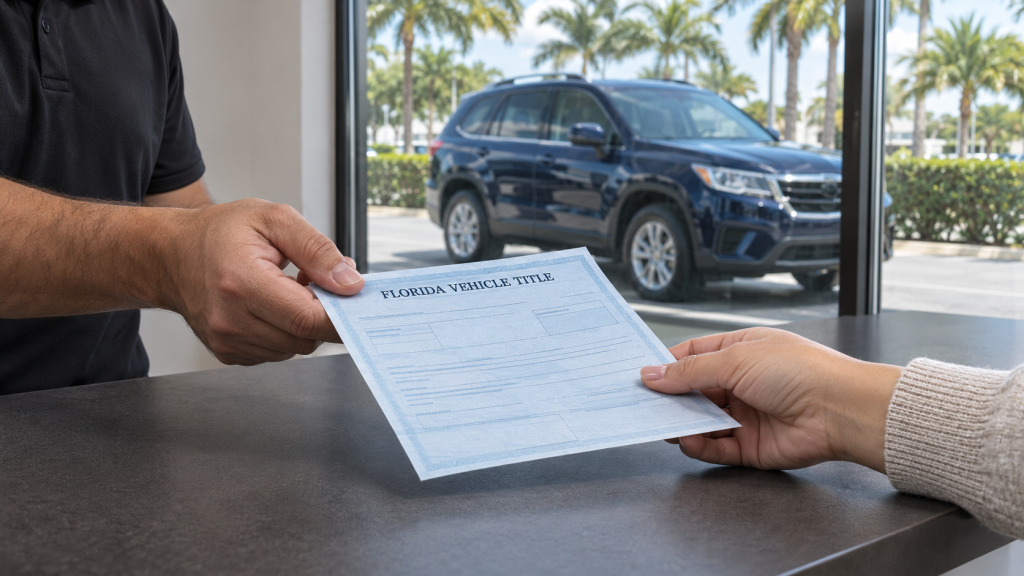
A retail customer’s tag-and-title packet and a dealer’s acquisition file do different jobs. HSMV 82040 is the title application. HSMV 82050 is the Notice of Sale and/or Bill of Sale. Neither replaces the assigned certificate of title, and a bill of sale alone does not transfer ownership. A Florida buyer generally must file within 30 calendar days of delivery, and a $20 late penalty applies at 30 days or more.
Every VIN should clear the same pre-funding checklist, with a named owner for each field:
- BDC intake: paper or electronic title, lien status, seller name as it appears on the title
- Buyer: seller ID, ownership match to the vehicle record, odometer disclosure, purchase price
- Central title clerk: every required owner signature, delivery date, assignment integrity (no blank or altered assignments)
Run this list first, because every defect found after payment is a defect you own. A missing co-owner signature caught at intake costs a phone call. The same defect caught after the car is on your lot costs a held unit and a seller who has already spent the money.
This article describes operating practice, not legal advice. Confirm edge cases with the Florida Highway Safety and Motor Vehicles (FLHSMV) and your own counsel. County tax collectors and service centers process many of these transactions, so local handling can differ.
What Happens When the Title Isn’t Clean?
Most title problems fit a short list, and each deserves a default action decided in advance. Here is the exception matrix in plain terms:
- Missing signature or absent co-owner: do not fund until every required owner has signed. Owner: central title clerk.
- Name mismatch with the title: hold. Escalate to the compliance lead before any offer is finalized.
- Blank or altered assignment: do not fund. Do not accept a reassignment you cannot trace.
- Lost title: hold until the seller completes the replacement path with FLHSMV.
- Active lien: buy subject to payoff, with the controls below.
- Electronic title: buy only with a verified path (see below).
- Out-of-state title: hold for VIN verification and added title requirements.
Electronic and out-of-state titles
An electronic title cannot be signed over like paper. It may need HSMV 82994 or an in-person secure reassignment workflow, and the seller may need to appear at a service center. Keep these deals out of inventory until the path is confirmed and documented. Out-of-state units do not follow the Florida form path by default, so flag VIN verification and added requirements at intake rather than discovering them at titling.
Lien-payoff procedure
Before purchase, collect the payoff letter, the lender contact, and the account holder’s authorization to speak with the lender. After payoff, retain the lien release and the payment confirmation. Block the unit from retail sale until the release is in the file and the title reassignment is complete.
Pro Tip: A verbal payoff quote is no quote. Payoff figures change daily, and a letter with a per diem is the only number worth funding against.
Build a VIN-Level Title-Readiness Scorecard
A central team needs one status per VIN that anyone can read at a glance. Think of it as a traffic light for every unit in the pipeline. Use a ladder of six pre-purchase statuses: Clear to Buy, Buy Subject to Payoff, Electronic Title Action Required, Out-of-State Verification Required, Missing Owner Signature, and Do Not Fund. No status, no funding.
After purchase, the same VIN moves through a queue:
- Payoff sent
- Lien release received
- Title reassignment completed
- Title packet audited
- Vehicle entered into inventory
- Retail title application submitted
Gates and owners
Assign each gate an escalation owner so no single buyer can override it on a high-pressure deal. Payoff exceptions go to the controller or title lead. Owner-identity and odometer exceptions go to compliance. Out-of-state exceptions go to the central title clerk. A buyer can request an override but cannot grant one.
The audit trail
Tie every record to the VIN: signed title images, HSMV forms, payoff proof, seller verification, payment evidence, and delivery records. Set a retention rule your compliance lead can defend, and apply it uniformly across rooftops. This file is also your evidence if a seller later receives tolls or tickets on a car you already own.
Capturing the data upfront
Most of these fields can be collected before an offer exists. First-Party Lead Funnels and AI Intake Systems can ask for title type, lienholder, and payoff details at submission, then route exceptions to a human.
Vehicquire is the only agency built 100% for private-party vehicle acquisition using custom AccuTrade API technology and first-party funnels, so title status can sit beside appraisal data in one acquisition record. Automation here is triage. It flags and classifies, and your team still makes the call.
Stop Treating Resale Titling as an Afterthought
A centrally acquired unit runs on two clocks. The first is the acquisition title reassignment. The second is the dealer’s obligation to apply for the retail buyer’s tag and title, generally within 30 days. A private buyer files on their own, but a licensed dealer selling at retail handles the application, so the deadline becomes yours.
In a multi-rooftop group, decide in writing who owns that deadline when one rooftop buys and another sells. A workable rule: the central title clerk holds the packet until the unit is assigned, and the selling rooftop owns the 30-day retail deadline from the delivery date. The same person should answer when the file is incomplete.
Build a short post-acquisition checklist before front-line ready:
- Title reassignment status confirmed
- Lien release on file, if applicable
- Retail buyer application prepared
- Temporary tag handling set
- Florida versus out-of-state retail buyer differences noted
Title delays are not a back-office problem. A clean acquisition file shortens days-to-front-line, and a defective one turns a unit into a stuck asset that ties up floorplan and lot space. Reports suggest title and payoff gaps are among the common causes of that delay, which is why the gating belongs at intake.
If you are building toward 100-400 private-party units a month, the process has to hold at that volume without heroics. Book a Discovery Call and we will map your intake, funding gates, and title-readiness workflow to your rooftops. Apply the Florida title transfer rules buying centers need to follow as gates, not paperwork, and the volume stops being a risk.
Frequently Asked Questions
Can a Florida dealer buy a car from a private seller if the seller still has a loan?
Yes, as a buy-subject-to-payoff deal. Collect a payoff letter, lender contact, and the seller’s authorization before purchase, then retain the lien release and payment confirmation afterward.
Can a buying center pay the seller before the lien release or paper title arrives?
Funding before either arrives is a risk decision, not a legal shortcut. Many groups fund against a verified payoff letter and block the unit from retail sale until the release and reassigned title are in the file.
What should a dealer do when the seller’s name does not exactly match the title?
Hold the deal and escalate to your compliance lead. Do not fund until the mismatch is explained and documented, since ownership match is a core pre-funding check.
What if the Florida title is electronic and the seller cannot visit the service center?
Do not move the unit into inventory without a verified path. HSMV 82994 or an in-person secure reassignment workflow may be required, so confirm the route with FLHSMV before funding.
Can a Florida dealer buy a vehicle with an out-of-state title without first obtaining a Florida title?
Out-of-state units can follow a different path, with VIN verification and added title requirements. Confirm the specifics with FLHSMV rather than assuming the Florida form sequence applies.